
Growth Architecture Insight
Google Rental Ads Explained: What the Shopping-Style Format Could Mean for Residential Rentals
A practical, carefully sourced guide to the Google Shopping-style rental advertising concept, property-feed preparation, measurement, and housing-ad policy considerations.
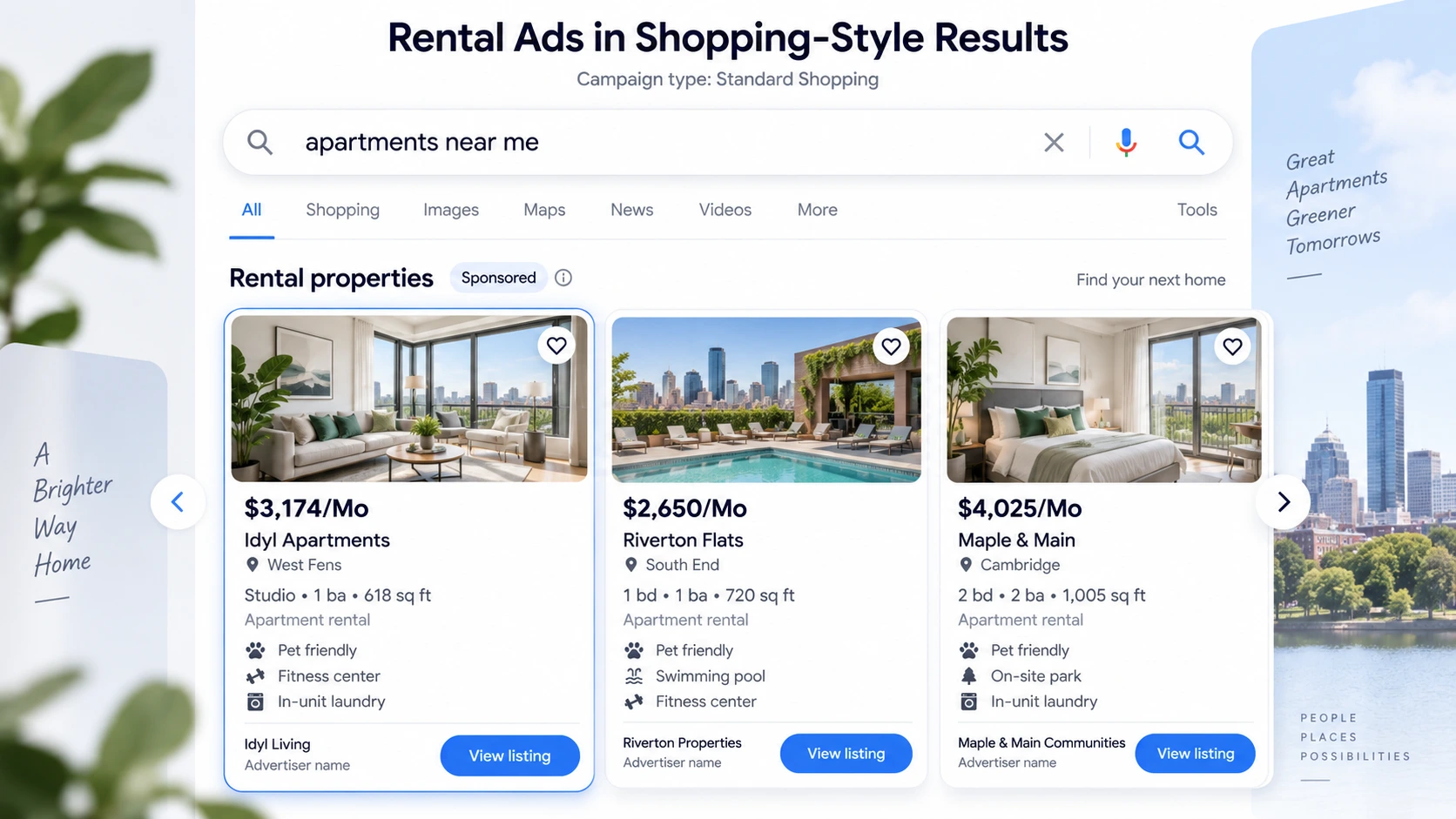
Property search is becoming more visual, more comparison-oriented, and more dependent on structured inventory. That creates an obvious question for residential rental marketers: could a Shopping-style format help a prospective tenant compare homes before they ever reach a property website?
This guide uses Google Rental Ads as a practical label for that opportunity. It does not present a new Google product launch as confirmed. Google’s public documentation confirms Shopping ads, Merchant Center product data, real-estate and rental business types in dynamic remarketing, and special housing-ad policy requirements. It does not, in the public sources reviewed for this article, confirm a separate residential Rental Ads product built on Standard Shopping inventory.
What are Google Rental Ads?
In plain language, Google Rental Ads describes the idea of presenting residential rental inventory in a comparison-friendly, Shopping-style experience. A listing could potentially give a renter a faster view of the property, price, location, availability, and a path to learn more.

The important distinction is between a useful market concept and a verified product name. Google’s official About Shopping ads documentation at https://support.google.com/google-ads/answer/2454022?hl=en says Shopping ads use product data from Merchant Center and can run through Shopping or Performance Max campaigns. That is a verified foundation for structured commercial advertising. It is not, by itself, confirmation that ordinary residential rental listings can be submitted as Standard Shopping products.
What Google officially documents today
Three pieces of Google documentation are especially relevant. First, Shopping ads use structured Merchant Center data to show product information such as an image, title, price, and store name. Second, Google documents “Hotels and rentals” and “Real estate” as business types for dynamic remarketing, with details such as listing names, prices, locations, and related attributes. Third, Google’s housing policy applies to homes and apartments for sale or rent in the United States and Canada.
That evidence supports preparing high-quality, structured rental information and treating policy review as part of campaign design. It does not support claiming an official Google Rental Ads launch, a guaranteed rental carousel, or a confirmed Standard Shopping feed format for residential properties.

Which claims are still unverified?
The following claims should be treated as owner-supplied hypotheses or forward-looking implementation assumptions until Google publishes a matching product specification: a dedicated residential Rental Ads placement, a new rental-property carousel, mandatory fields for monthly rent, beds, baths, square footage and amenities, and a fixed conversion flow from ad to availability request.
That distinction matters. A credible rental marketing plan can still be built around those fields, but the plan should label them as preparation guidance rather than promise a placement or feature that a platform may not offer.
What property data should a rental marketer prepare?
Even where the final media format is uncertain, clean inventory data improves every downstream experience. Prepare a stable record for each property or unit with:

- A clear property title and natural description
- A current monthly rent and fee explanation
- Bedrooms, bathrooms, square footage, and property type
- Address, neighbourhood, city, and service area
- Availability date and lease terms
- High-quality original images with useful alt text
- A canonical detail page and a clear inquiry action
- A last-updated timestamp and a process for removing unavailable units
Do not place stale availability, bait pricing, or unsupported amenity claims into a feed. Structured inventory amplifies both accuracy and inaccuracy, so the source system needs an owner and a refresh schedule.
How might a Shopping-style rental journey work?
The likely value of a structured rental experience is reduced comparison friction. A renter could discover a property, compare the essentials, open a detail page, check availability, and request a viewing or application. The exact Google surface is not confirmed here, so the journey should be designed as a channel-flexible system rather than tied to one promised placement.
The landing page still matters. It should load quickly, show the same price and availability as the source inventory, explain qualification requirements without discriminatory language, and make the next action obvious. If the listing is unavailable, the page should offer comparable choices rather than a dead end.
Housing advertising requires extra care
Google’s official Housing in personalized advertising policy at https://support.google.com/adspolicy/answer/16701755?hl=en treats homes and apartments for sale or rent as housing in the United States and Canada. The related housing, employment, and credit policy FAQ at https://support.google.com/adspolicy/answer/9997418?hl=en explains that housing ads have restrictions on using or targeting sensitive demographic and location signals.
In practice, document the countries and locations in scope, review audience settings, avoid protected-class proxies, and have policy counsel review the campaign where the market or targeting model is complex. Do not assume that a compliant-looking creative makes every audience setting compliant.
How should rental campaigns be measured?
Measure the business outcome, not just the impression. A useful measurement plan connects listing exposure to detail-page engagement, availability checks, qualified inquiries, booked tours, completed applications, and signed leases where consent and operational systems allow.
Keep a clean separation between property-level inventory metrics and person-level lead data. Use event names that describe the action without exposing names, email addresses, phone numbers, messages, or raw identifiers to analytics systems. Reconcile platform conversions against the CRM so that an unavailable unit does not continue to generate “success” events.
What should a rental advertiser do next?
For a broader acquisition plan, see https://analytix9.com/lp/google-ads-agency/ and https://analytix9.com/services/. For measurement or feed architecture questions, contact the Analytix9 team at https://analytix9.com/contact/ with the inventory model and markets you serve.
Google Rental Ads FAQ
Is Google Rental Ads an official Google product?
Not confirmed by the public official sources reviewed for this article. “Google Rental Ads” is used here as a practical label for a Shopping-style residential rental advertising concept. Google officially documents Shopping ads, Merchant Center, rental and real-estate remarketing business types, and housing policy requirements.
Can residential rentals use Standard Shopping today?
Do not assume that they can. Google’s Shopping documentation describes product-data advertising, but the reviewed public pages do not confirm residential rental listings as an eligible Standard Shopping inventory type. Verify current eligibility with Google before committing budget or promising a placement.
Which fields should a rental feed include?
Prepare the fields a renter needs to compare a property: title, price, location, availability, property type, bedrooms, bathrooms, size, images, fees, lease terms, and a canonical detail URL. Treat any platform-specific required field as unverified until the current product documentation confirms it.
Are housing ads subject to special targeting rules?
Yes. Google’s housing policy covers homes and apartments for rent and restricts certain demographic and location targeting in the United States and Canada. Review the current policy and account settings before launch.
What is the best landing page for rental traffic?
Use a fast property detail page that matches the ad’s price and availability, explains the next step, provides accessible contact options, and offers comparable listings when the selected unit is no longer available.
How can Analytix9 help with rental advertising?
Analytix9 can help review the acquisition path, structure measurement, improve landing-page clarity, and coordinate paid-media and feed-readiness decisions. The appropriate scope depends on the inventory source, markets, consent model, and conversion system.